Why this exists
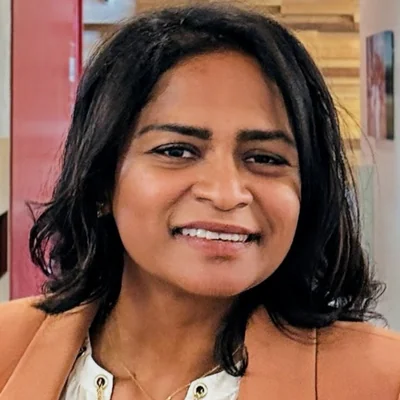
I spent fifteen years in math classrooms, teaching every level from pre-algebra through calculus, and I kept running into the same problem with the real students in front of me. The tools that help a concept stick existed, manipulatives a student can turn in their hands, visuals that make an abstract idea concrete, the small human moments that anchor a memory. None of it was new. What was missing was a place where a student could reach all of it at once, the moment they needed it, without a teacher assembling it by hand every time.
So I built that place, to solve a real problem in my own classroom, for my own students.
I am Nivedita Godavarthi, a teacher, an engineer, and a human centered systems thinker. I built My Math Learning Hub for the student who has come to believe they are not a math person. Every student can learn math. The variable is the path, not the person, and when a student is stuck, it means they have not been given the path that matches how they learn, and I built this platform so every student can find their path.
What I learned in the room
Most of what shaped this platform came from my own classroom, honestly observed and tested over years. People might call that informal research, and I will push back, because it carries an apology I do not accept.
Teachers are researchers. We are in the room every day, watching what works and what does not the instant it happens. We know our students more deeply than anyone, because we sit with them, adapt, adjust, and we rack our brains to find ways to make a concept connect and stick. That is not a lesser form of knowledge than a study run in someone else's classroom. In many ways it is truer, and more powerful because it is daily, it is relational, and it never stops correcting itself for a real child in front of us. That knowledge cannot be replicated from the outside, and it deserves to be elevated, not treated as a footnote to any formal work. This platform is built on that conviction, by a teacher, to work alongside every teacher in the room.

What this taught me is that students learn when they feel something. They held on to a concept when they had touched it, dragged it, connected it to a name they knew or a story we had already lived together. A dog named Aurora shows up throughout this platform for that reason. I used her to make an abstract idea something a student could attach to and remember. But emotion alone does not teach math, and this is the whole design. We center emotion because it is the strongest carrier of learning, and then we build, around it, the conditions that actually produce retention. Concrete, representational, and abstract, all held together at once, so a student sees how the picture, the symbol, and the thing they can touch are the same idea. Repetition shaped to build mastery without overwhelming working memory. Misconceptions are observed intentionally and answered the moment they appear, not marked wrong and left behind. Every one of those choices is grounded in how the brain works under load, not in what looks impressive on a screen.
What it is, and what it refuses to be
My Math Learning Hub is built for the way real brains learn math, with neurodiverse students at the center of the design rather than at its margins. It refuses three things on purpose.
It refuses to replace the teacher. There is no chatbot a student talks to instead of a person, no synthetic relationship standing in for a real one. The relationship between a student and their teacher stays at the front of everything, and the platform's job is to make it tighter, never to dilute it.
It refuses to do the thinking for the student. Students complete every step themselves, at their own pace. There is no auto-solve and no skipping to the answer. Every click is a decision a student learns from.
And it refuses to pull students away from the desk. I still want a notebook open and a pencil moving on paper. The platform brings together what students need, lets them reach for the right tool at the right moment, and sends them back to the work with their own hand.
Why I am the one who built it
A platform like this needs two kinds of knowledge that rarely sit in the same person. Fifteen years across every level of math, working most closely with the students other approaches had failed, is what shaped every pedagogical decision in it. That same instinct, designing how people actually learn, shows up in the experiential learning I build beyond the classroom too, and this platform is where I pointed it at one hard problem in math. The engineering is what let me build it correctly. Because I am an engineer as well as a teacher, the learning decisions and the technical ones are made by the same person and answerable to each other all the way down.
That discipline is also why it lasts. The platform runs on real, documented infrastructure, built to be stable and maintainable rather than fragile, so it does not depend on any one person holding it all in their head. Its maintenance is shared, and it is the kind of system a capable engineer can step into and extend. A school is right to ask what a learning platform depends on and how it holds up over time, and this one is built to be durable now and to grow by bringing the right people into a sound system.
I take student privacy seriously. It was a core principle from the start, built into the architecture rather than bolted on as an afterthought for marketing at the end. You can read exactly what we collect, what we never collect, and how it is protected in our privacy policy.
What I have actually seen
Rather than make claims I cannot stand behind, let me tell you something I watched happen.
One of my students learns very differently from the way school is usually taught, and much of their experience of math had been shaped by that mismatch. On this platform they worked through the substitution and elimination lessons at their own pace, with their misconceptions caught and answered as they went, and they reached full mastery. They enjoyed learning this way, not because things were made easier, but because the path finally fit how they learned.
That is the entire point. The student was never the problem. The fit was.
What I believe
I believe every child is a blessing, and I mean it as a working principle, not a sentiment. It is why a student is never made to feel the difficulty is theirs to carry alone, why the teacher stays at the center, and why every part of this was built with such care.
We have known for a long time that students do not all learn the same way, and I built the platform that finally takes that knowledge seriously. If you are working on the same problem, let's connect: nive@mymathlearninghub.org.
— Nivedita Godavarthi, Founder
www.mymathlearninghub.org